
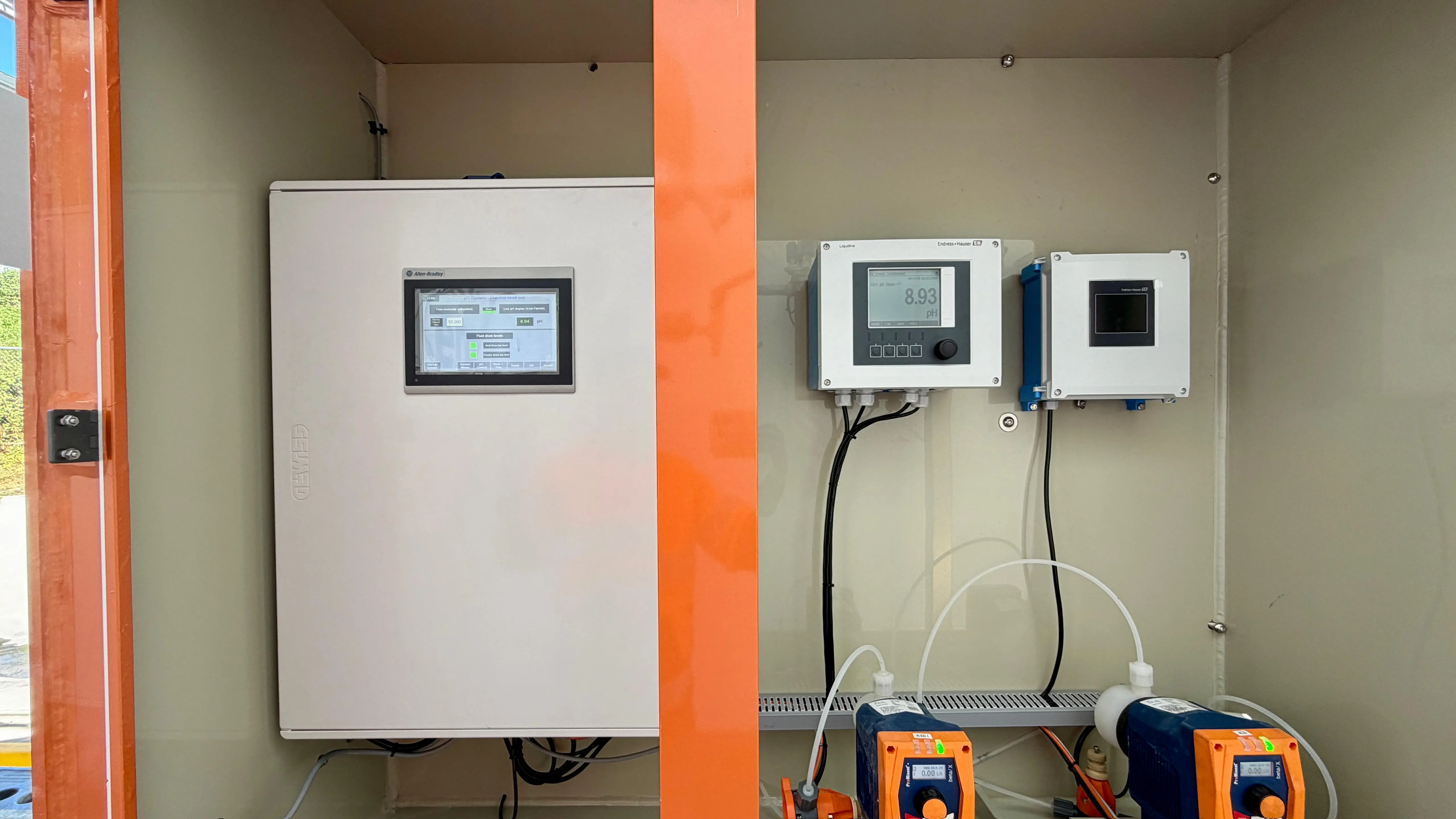
In large-scale food production, process stability is everything. When you are operating at the level of New Zealand’s largest chicken producer, pH control is not just a parameter, it directly impacts food safety, compliance, and plant continuity.
This project was led by Lionel Needham, owner of 𝗜𝗻𝗱𝗲𝗽𝗲𝗻𝗱𝗲𝗻𝘁 𝗘𝗹𝗲𝗰𝘁𝗿𝗶𝗰𝗮𝗹 𝗜𝗻𝗱𝘂𝘀𝘁𝗿𝗶𝗮𝗹 𝗦𝗼𝗹𝘂𝘁𝗶𝗼𝗻𝘀, who acted as the main contractor. Lionel designed and built the complete electrical board and infrastructure for the system, and invited Dutch Automation & Technologies to deliver the automation scope and control strategy.
𝘛𝘩𝘦 𝘌𝘯𝘨𝘪𝘯𝘦𝘦𝘳𝘪𝘯𝘨 𝘊𝘩𝘢𝘭𝘭𝘦𝘯𝘨𝘦
The process environment involves:
• Continuously refreshed water streams
• Fluctuating flow conditions
• Variable chemical demand
• Strict upper and lower pH control limits
This was not a simple fixed setpoint application. The client required controlled band monitoring with intelligent correction, ensuring stability without oscillation, and protection against overshoot in a high-throughput environment.
𝘛𝘩𝘦 𝘊𝘰𝘯𝘵𝘳𝘰𝘭 𝘚𝘵𝘳𝘢𝘵𝘦𝘨𝘺
Working within the electrical architecture provided by IEIS, we implemented:
• Flow-proportional base dosing
• Structured acid/caustic correction logic
• Defined upper and lower limit protection
• Stable PID trim control
• Robust analog scaling and output clamping
• Safe behaviour on restart and fault detection
The result is a predictable and industrial-grade dosing system designed for uptime and compliance, not theoretical lab conditions.
Credit Where It’s Due
Lionel’s board design, layout, and execution created the foundation for a clean and reliable automation implementation. Strong electrical engineering makes strong automation possible.
It was a privilege to support this project by invitation and contribute the control architecture to an already solid electrical platform.